Category 4 at Landfall

Hurricane Maria (2017)

Devastated Puerto Rico with Category 4 winds and caused complete power grid collapse lasting 11 months. An estimated 2,975 excess deaths resulted from infrastructure failure and inadequate recovery systems.

Last updated July 3, 2026

Hurricane Maria struck Puerto Rico on September 20, 2017, as a powerful Category 4 hurricane with maximum sustained winds of 155 mph (250 km/h).1 The direct devastation was catastrophic, and the deeper crisis unfolded in the months and years that followed, as the island's electricity grid collapsed completely. Power restoration took 11 months, the longest outage in U.S. history,1 leaving millions without electricity, refrigeration, water pumping, and medical life support. A George Washington University study documented 2,975 excess deaths attributed to the hurricane's aftermath, far exceeding official estimates.2 The $115.2 billion in damage (2024 CPI-adjusted)3 combined with the humanitarian crisis created by infrastructure failure made Maria one of the most consequential hurricanes in modern history.

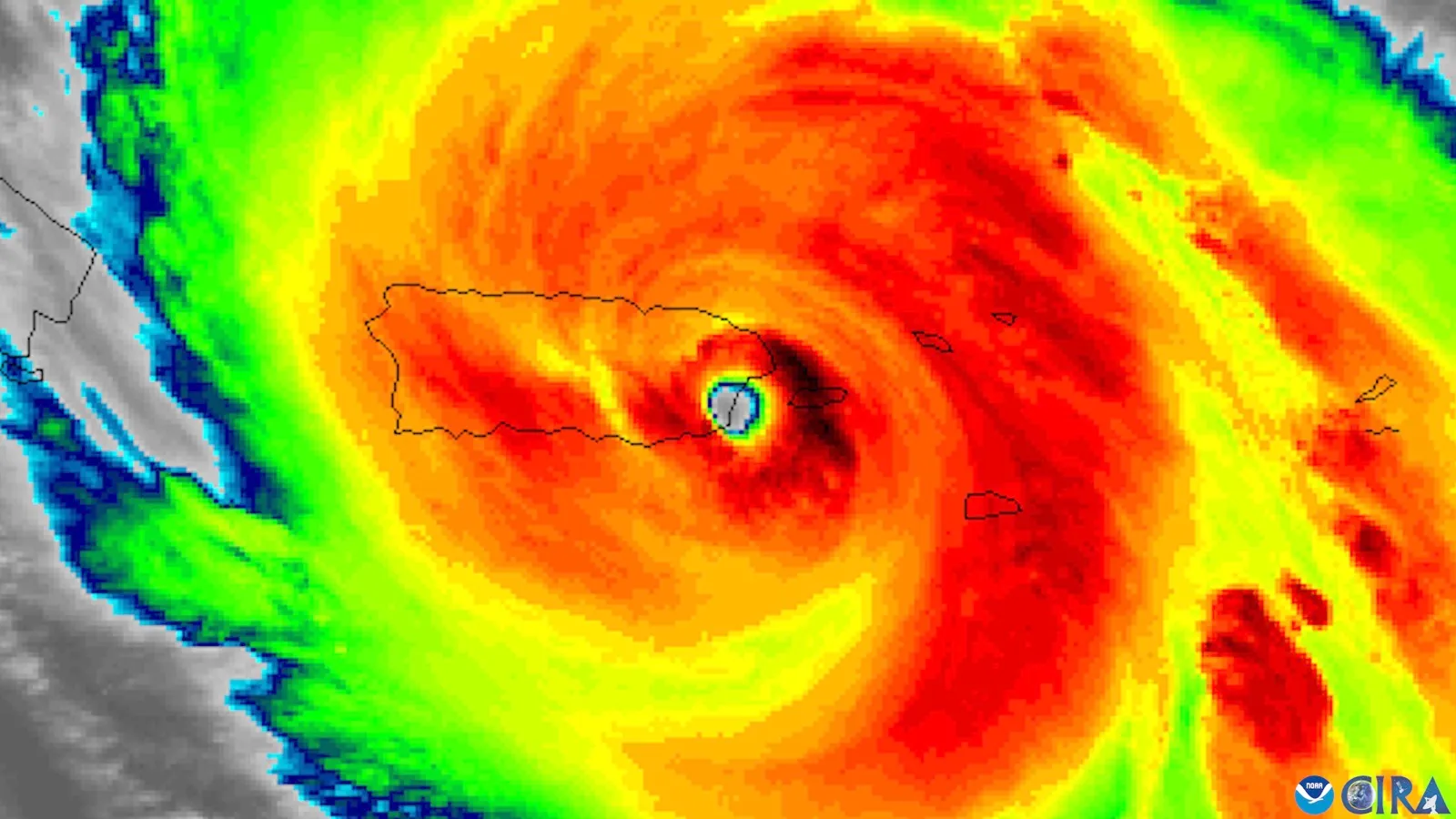
Satellite image of Hurricane Maria making landfall in Puerto Rico on September 20, 2017
Hurricane Maria making landfall in Puerto Rico as a high-end Category 4, September 20, 2017. Credit: NOAA / CIRA · Public domain

Meteorological History

Hurricane Maria formed from a tropical wave in early September 2017, becoming a tropical depression southeast of the Caribbean. As it moved westward through warm Atlantic waters and entered the Caribbean, Maria rapidly intensified. By September 18, Maria had explosively intensified into a Category 5 hurricane with maximum sustained winds of 175 mph (280 km/h) and a minimum central pressure of 908 mb, among the most intense Atlantic hurricanes on record. It weakened slightly to a high-end Category 4, with sustained winds near 155 mph (250 km/h), just before reaching Puerto Rico.1

Landfall and Destruction

Maria made landfall on September 20 near Yabucoa, Puerto Rico, as a Category 4 hurricane.1 The eyewall directly crossed the island from southeast to northwest, subjecting the entire island to extreme winds, torrential rainfall, and severe storm surge. Wind damage was widespread and catastrophic: roofs were completely removed from structures, vegetation was stripped bare, and transmission towers were toppled. Severe as that wind damage was, the aftermath is what defined Maria.
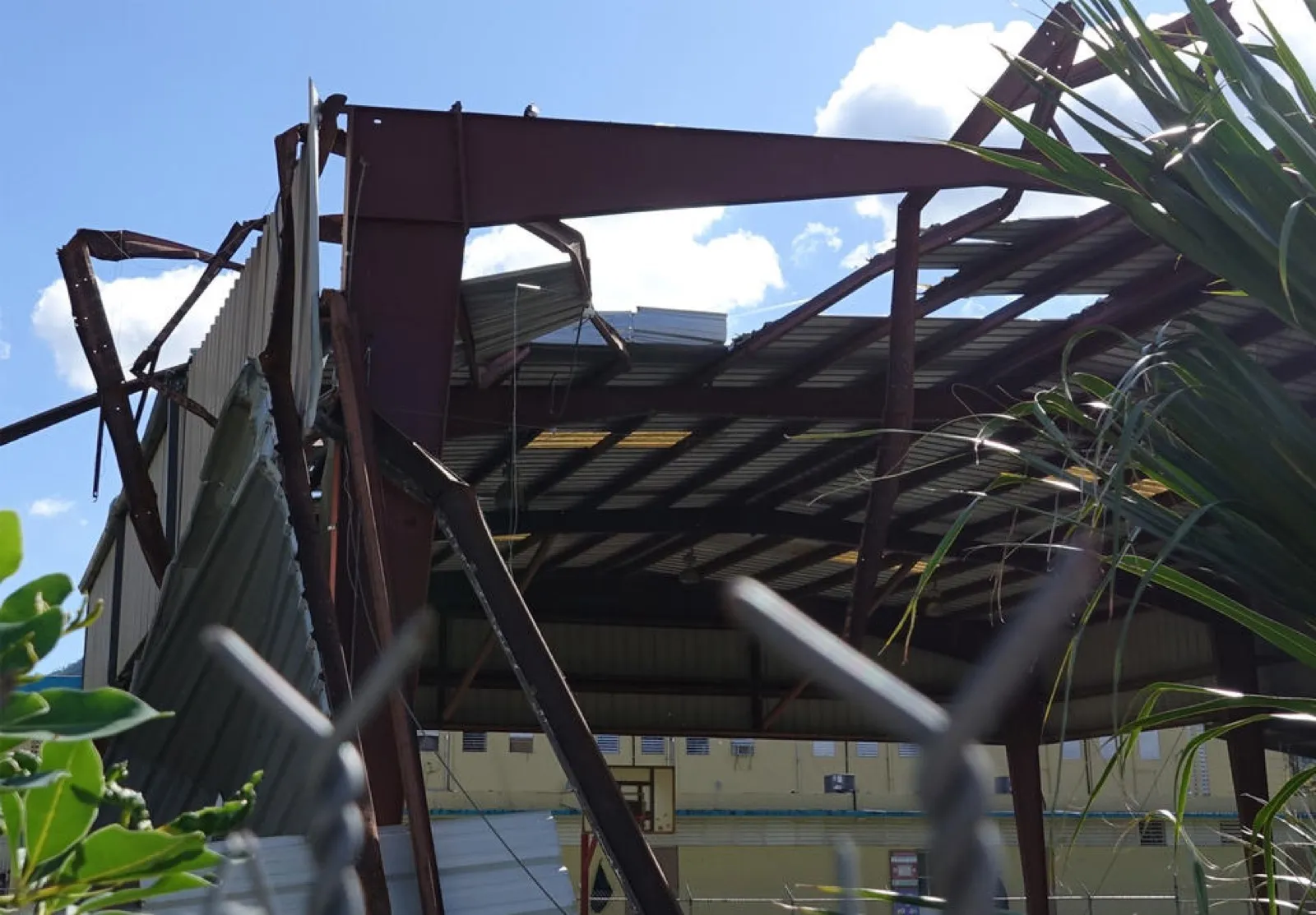
A structure collapsed over a basketball court in Cayey, Puerto Rico after Hurricane Maria
A collapsed structure in Cayey: Maria's winds stripped roofs and flattened buildings across the island. Credit: NIST · Public domain

Infrastructure Collapse & the Power Crisis

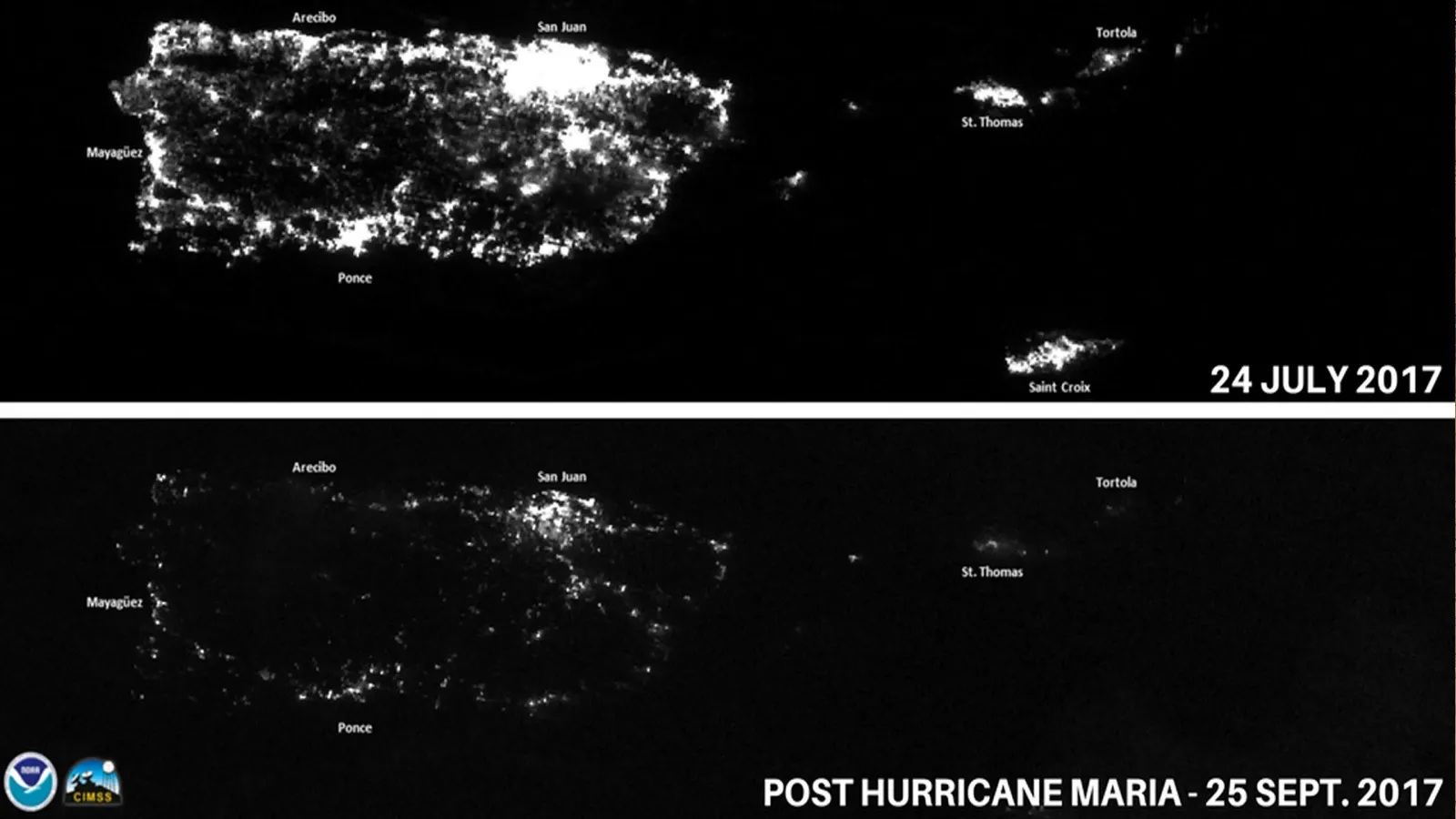
Hurricane Maria destroyed Puerto Rico's already-fragile electrical infrastructure. Prior to the hurricane, the Puerto Rico Electric Power Authority (PREPA) was in financial distress and had deferred maintenance. Maria's extreme winds destroyed transformers, transmission towers, and distribution lines across the island. The power system went completely offline. While some generation was restored in days, complete restoration took 11 months, longer than any other major power outage in U.S. history.1

Satellite night-lights of Puerto Rico before and after Hurricane Maria, showing the island gone dark
Puerto Rico's night lights before and after Maria: the island-wide grid collapse was the longest blackout in U.S. history. Credit: NOAA NESDIS · Public domain

The humanitarian consequences of prolonged power outage were severe. Hospitals operated on diesel generators that ran out of fuel. Dialysis patients had no power for life-sustaining equipment. Water treatment plants could not function, leading to contaminated water supplies. Food spoiled in powerless refrigerators. Heatstroke and heat-related illnesses increased. Communication systems failed, hampering emergency response. Funerals were delayed because mortuaries lacked refrigeration. The extended outage created cascading failures across all critical infrastructure.

Human Toll & Excess Mortality

Official death tolls from Hurricane Maria were initially reported as 64, but this dramatic undercount missed the indirect deaths from infrastructure failure. A comprehensive study by George Washington University researchers published in 2018 estimated 2,975 excess deaths, deaths that would not have occurred but for the hurricane and its aftermath.2 The causes included medical system collapse, untreated chronic diseases, stress-related mortality, and heat-related deaths.

The gap between the initial official count of 64 and the 2,975 excess deaths is the whole story of Maria, and it is the number we cite most often. Almost none of those additional deaths came from wind or water on the day of landfall; they came from a power grid that stayed down for months, and from the hospitals, dialysis centers, and water systems that could not run without it. Maria is the case that convinced many of us that grid resilience is not a utility problem to be sorted out after the storm, but a life-safety system that belongs in the same category as the levees and the building code.

The excess death count revealed how vulnerable populations are to extended infrastructure failure. Elderly residents dependent on electrically-powered medical equipment died when generators failed. Patients with chronic diseases, diabetes and heart conditions, died without access to medication or medical care. Mental health deteriorated under prolonged stress, contributing to suicides and stress-related illnesses. Puerto Rico's elderly population was disproportionately affected, with mortality spikes documented 6–8 weeks post-hurricane as deferred medical care and stress accumulated.

A resident of Barranquitas, Puerto Rico receives food and water weeks after Hurricane Maria
A resident of Barranquitas receives food and water weeks after Maria, as relief slowly reached remote inland towns. Credit: U.S. Air Force / Tech. Sgt. Larry Reid Jr. · Public domain

Economic Impact & Long-Term Recovery

Hurricane Maria caused $115.2 billion in damage (2024 CPI-adjusted),3 devastating an island economy already struggling with debt crisis and population loss. The hurricane accelerated Puerto Rico's demographic decline, with an estimated 5–10% of the population emigrating to the mainland United States in the two years following the hurricane. Tax revenue collapsed; government services were reduced; and private investment declined. The economic recovery has been prolonged and incomplete, with Puerto Rico's economy still below pre-Maria levels nearly seven years later.

Workers repairing the electrical grid on Vieques, Puerto Rico after Hurricane Maria
Crews repair the grid on Vieques: full power restoration across Puerto Rico took 11 months. Credit: Western Area Power / Jeff Miller · CC BY 2.0

The disaster exposed systemic vulnerabilities in Puerto Rico's governance and infrastructure. Federal disaster assistance was slow and inadequate. The private electrical utility lacked capacity to restore power quickly. The government lacked disaster management experience and resources. Maria became a catalyst for national conversation about the vulnerability of island territories and the federal government's responsibility to ensure equitable disaster response.

We would add one honest caveat about the 2,975 figure: excess-mortality estimates are statistical, not a roll of named individuals, and they carry uncertainty, which is part of why the early official count was so low. That uncertainty does not undo the finding; it is why counting the dead after a disaster this diffuse is its own hard problem, and why the number was contested for years. For how federal aid is meant to reach a place like this, see government aid after a hurricane; for the wider economic damage, the economic ripple effects of hurricanes.

Sources

  1. National Hurricane Center. (2019). Tropical Cyclone Report: Hurricane Maria (AL152017). NOAA. https://www.nhc.noaa.gov/data/tcr/AL152017_Maria.pdf 2 3 4 5

  2. Milken Institute School of Public Health, George Washington University. (2018). Ascertainment of the Estimated Excess Mortality from Hurricane María in Puerto Rico. https://research.gwu.edu/gw-researchers-2975-excess-deaths-linked-hurricane-maria 2

  3. NOAA National Centers for Environmental Information. (2024). U.S. Billion-Dollar Weather and Climate Disasters. https://www.ncei.noaa.gov/access/billions/ 2