Hurricane Andrew was the most destructive hurricane in U.S. history when it struck in August 1992, and it remains one of only four Category 5 hurricanes on record to make landfall on the U.S. mainland. Its violent winds flattened entire neighborhoods in south Miami-Dade County, exposed catastrophic failures in construction quality, and forced a reckoning that permanently reshaped Florida's building codes and the property-insurance industry.
Meteorological History
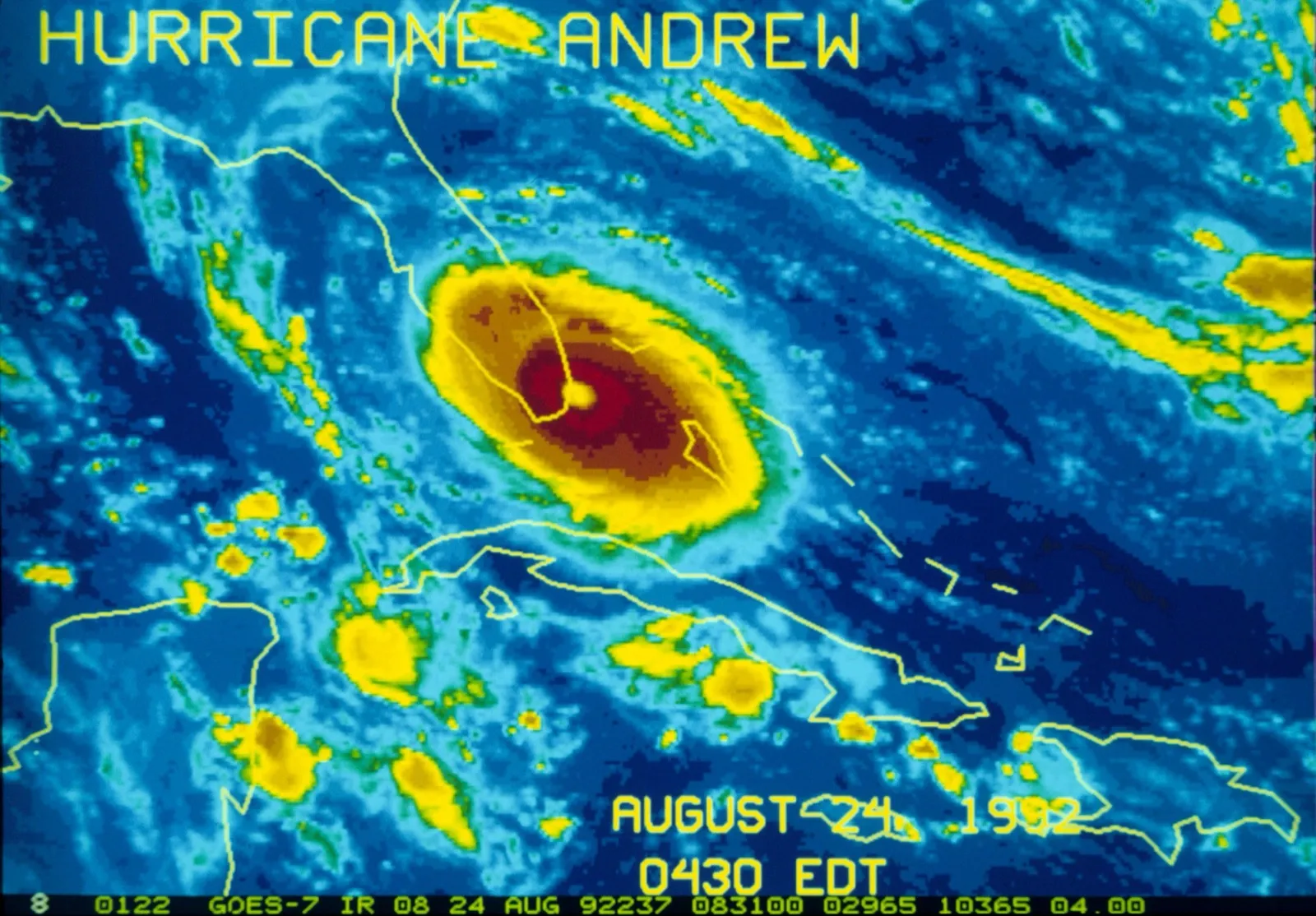
Andrew began as a tropical wave that moved off the coast of West Africa in mid-August 1992. For several days it battled strong wind shear and nearly dissipated. But as it approached the Bahamas, conditions turned favorable and the storm underwent rapid intensification.1 NHC upgraded Andrew in 2002; a detailed reanalysis published in 2004 documented the change in Andrew’s peak and Florida-landfall classification from Category 4 to Category 5, with peak sustained winds of about 175 mph (280 km/h) and a minimum central pressure of 922 mb.1
Landfall in South Florida
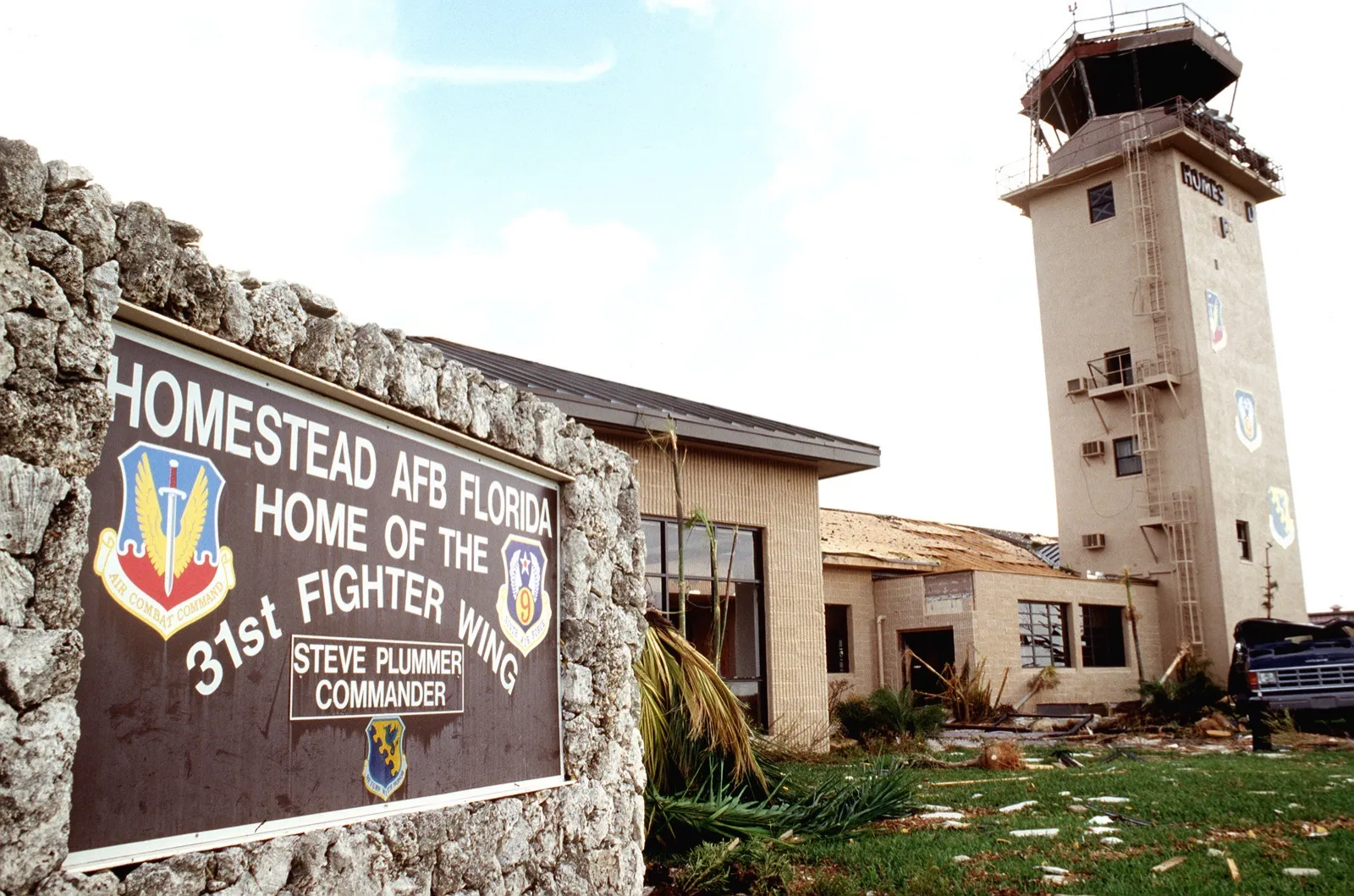
Andrew made landfall over Elliott Key and then near Homestead, in southern Miami-Dade County, early on August 24, 1992, with estimated maximum sustained winds near 165 mph (265 km/h): Category 5 intensity.1 The compact, fast-moving storm drove a storm surge of roughly 17 feet (5.2 m) into Biscayne Bay near the landfall point.2 After crossing the Florida peninsula and the Gulf of Mexico, Andrew made a second U.S. landfall in south-central Louisiana on August 26 as a Category 3.1
Catastrophic Damage
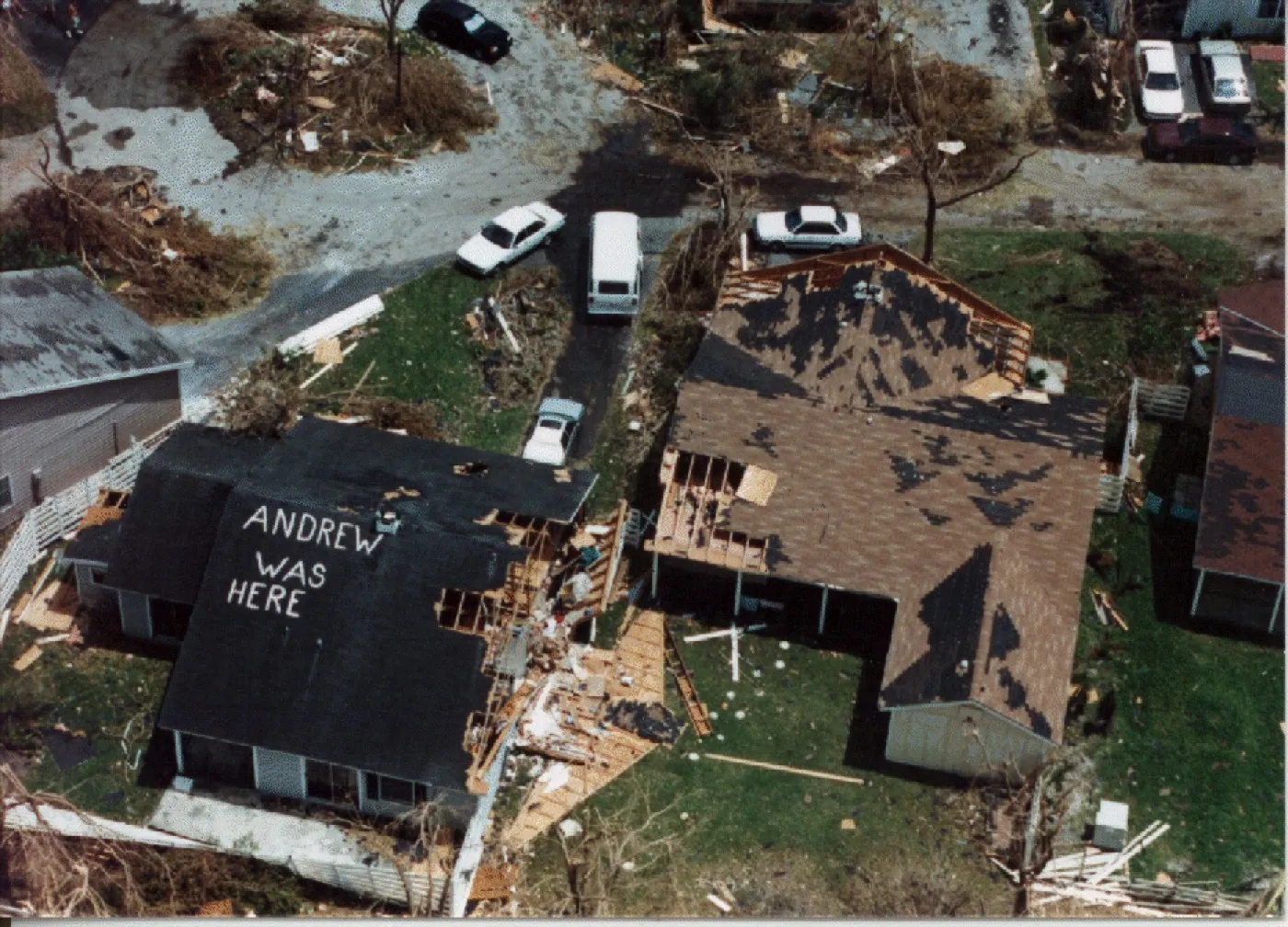
Destruction in south Miami-Dade was near-total in the hardest-hit areas. Andrew destroyed more than 63,000 homes and damaged well over 100,000 others, leaving roughly a quarter-million people temporarily homeless.3 It caused about $27 billion in damage in 1992 dollars, making it the costliest natural disaster in U.S. history at the time.3 Andrew was responsible for 65 deaths across the Bahamas, Florida, and Louisiana.2
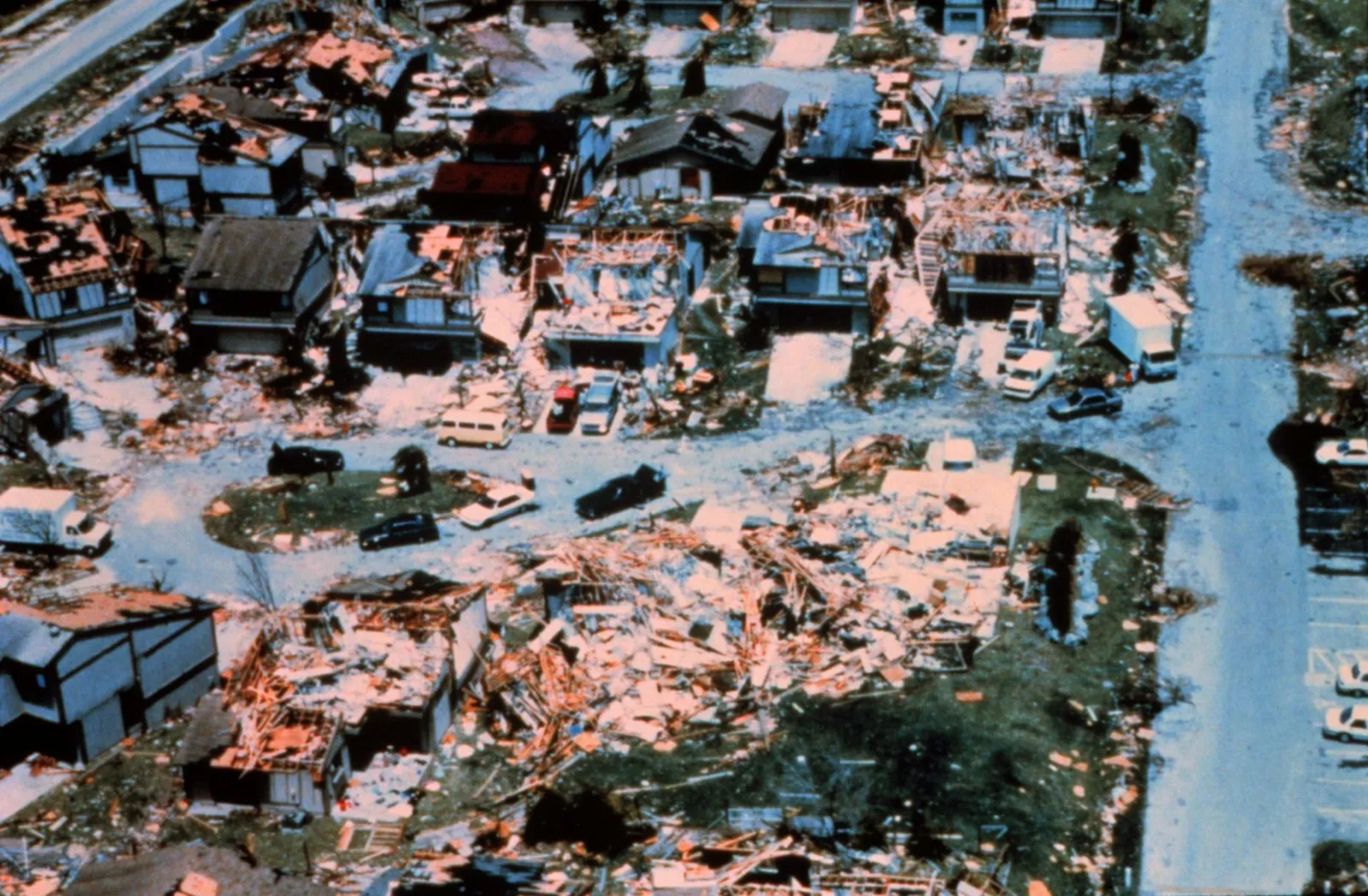
A defining lesson of Andrew was that much of the destruction was avoidable. Post-storm investigations found that a large share of the damage stemmed from poor construction quality and weak enforcement of building codes: roofs that peeled away, gable ends that collapsed, and homes that disintegrated once their building envelopes failed.
Andrew exposed failures in roof coverings, gable ends, and structural connections. Those findings helped motivate stronger construction standards and enforcement.
Transforming Building Codes and Insurance
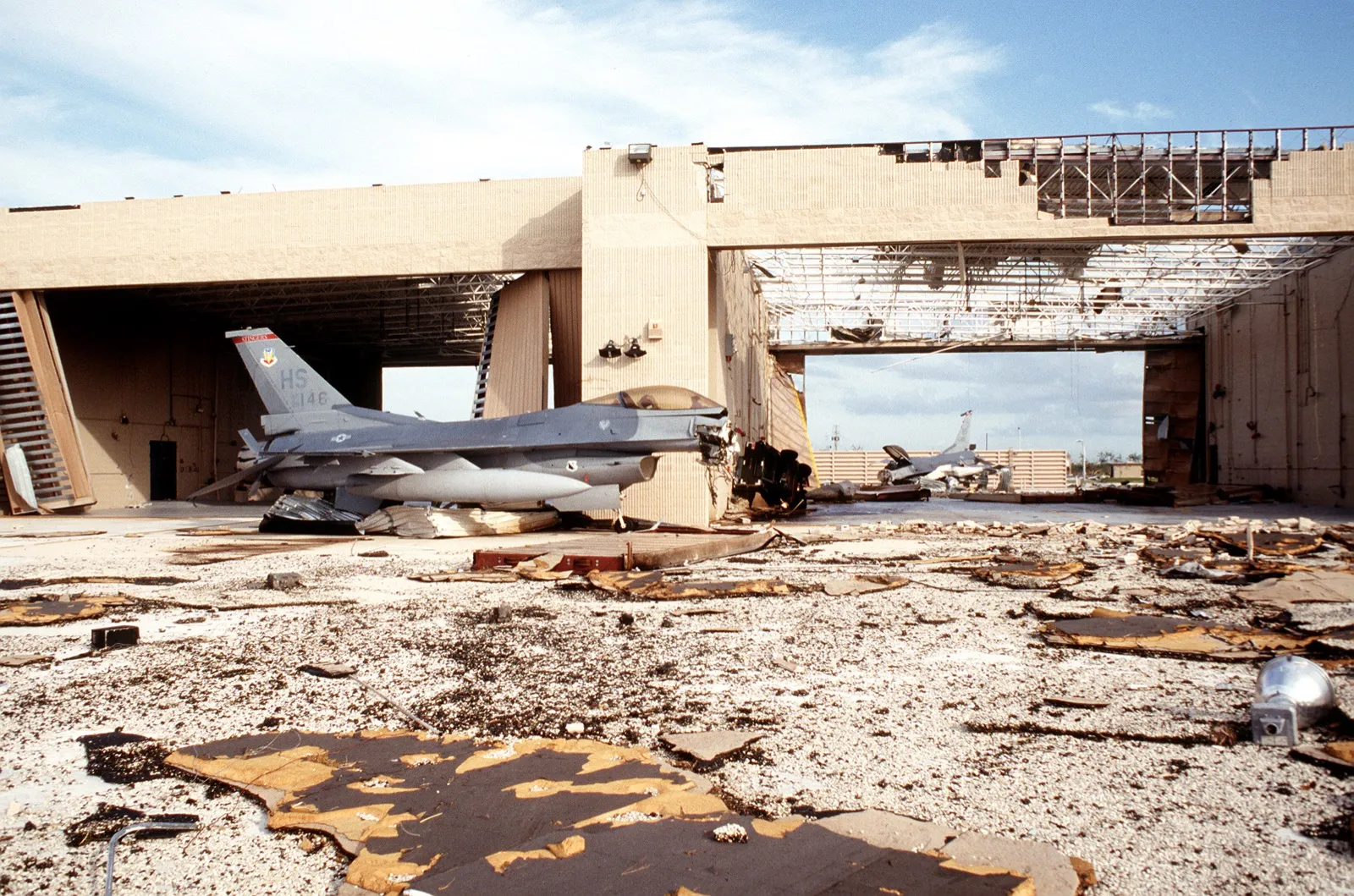
Andrew's aftermath drove sweeping reform. Florida overhauled its building regulations, ultimately replacing a patchwork of local codes with the statewide Florida Building Code, which took effect in 2002 with far stricter wind-resistance requirements, including impact-resistant openings and reinforced roof-to-wall connections in high-wind zones.4
The storm was equally transformative for insurance. Andrew's losses bankrupted at least a dozen insurers and prompted many national carriers to shed Florida exposure.5 In response, the state created mechanisms such as the Florida Hurricane Catastrophe Fund and, later, the state-backed insurer Citizens Property Insurance, structures that still shape Florida's volatile insurance market today.5
Legacy
Andrew permanently changed how the United States prepares for hurricanes. It proved that a compact, intense storm can be as devastating as a sprawling one, accelerated the modernization of building codes nationwide, and reshaped catastrophe insurance and reinsurance. It also spurred improvements in forecasting and emergency management that would be tested by later Category 5 landfalls. Decades on, Andrew remains the benchmark against which South Florida measures its hurricane risk.
Building performance and insurance affordability are distinct problems. Stronger construction reduces vulnerability, but premiums and market availability also depend on insured values, claims costs, reinsurance, and other factors.
Sources
-
Landsea, C. W., et al. (2004). A reanalysis of Hurricane Andrew's intensity. Bulletin of the American Meteorological Society, 85(11), 1699–1712. National Hurricane Center. https://www.nhc.noaa.gov/pdf/04landsea.pdf ↩ ↩2 ↩3 ↩4
-
National Hurricane Center. Tropical Cyclone Reports. NOAA. https://www.nhc.noaa.gov/data/tcr/ ↩ ↩2
-
NOAA National Centers for Environmental Information. U.S. Billion-Dollar Weather and Climate Disasters. https://www.ncei.noaa.gov/access/billions/ ↩ ↩2
-
Federal Emergency Management Agency. Building Science: Hurricane Andrew and the Florida Building Code. https://www.fema.gov/emergency-managers/risk-management/building-science ↩
-
Insurance Information Institute (2012). Hurricane Andrew and Insurance: The Enduring Impact of an Historic Storm. https://www.iii.org/sites/default/files/paper_HurricaneAndrew_final.pdf ↩ ↩2